Saturday, March 11, 2017

THE LIVING FORCE: THE REDEMPTION OF QUI-GON JINN


I think we need to take some time to explore the concept of redemption and enlightenment in STAR WARS, but there appear to be varying degrees of both. Now that we take another look at the original trilogy, we see that all good Jedis do not just majestically disappear as they cross over from the crude mortal plain to the living energy of the Force. Sometimes they come back as benevolent spirits, but sometimes not-so-good Jedis can also come back as spirits. 


And sometimes they just pop up years later, in a Special Edition, for no real reason.

Obi-Wan disappeared just as Darth Vader’s killing stroke cut him down in EPISODE IV and Yoda peacefully dissolved as he transitioned into what he described as a period of “forever sleep” in EPISODE VI. This was not the case for Darth Vader. Assuming Luke wasn’t just burying the robot parts on Endor, Anakin’s transition to the realm of the dead did not involve the dissolution of his mortal remains. 


So, good Jedis disappear and bad Jedis don’t, right? Not necessarily. Good and bad don't solely determine if you'll be a Force Ghost, since the end of EPISODE VI shows us that not only is Obi-Wan Kenobi a Force Ghost, but he’s since been joined by the ghosts of Yoda and Anakin too.


Depending on what version of the movie you're watching.


Whether it's the youthful visage of the Anakin we know from the prequels, or the elderly version of Vader's alter ego who was unmasked at the end of the original trilogy, we're led to believe that Anakin's spirit standing alongside the spirits of Yoda and Obi-Wan symbolizes the return of the Jedi he once was, having redeemed himself in the final moments of his life.

So, all Jedis become Force Ghosts, but only the good ones disappear when they die, right? Or you can be a ghost if you redeem yourself, but only the purest Jedi leave no corpse behind.

Right?

No. Not that either.


In our previous examination of the Living Force and the concept of the Force Ghost, we observed that Qui-Gon Jinn dispels both of those assumptions in the prequel trilogy. In EPISODE I, his body is burned on a pyre just as Vader’s is in EPISODE VI. In EPISODE III, we also learn that Qui-Gon posthumously develops the ability to return from the spirit world, a skill that he presumably teaches Yoda and explicitly will teach Obi-Wan Kenobi while he’s sitting around on Tatooine between movies.

We’ve examined two story arcs in the CLONE WARS series that expand on this idea, stating outright that Qui-Gon had been sent back to enlighten Yoda in order to put an end to the travesty of the Clone Wars.

So, only Qui-Gon Jinn, Yoda, and Obi-Wan Kenobi can become Force Ghosts, right?

Nope.

Qui-Gon was sent back to make things right and he instructed Yoda and Obi-Wan on how to do the same, but why does Anakin's spirit return - purged of the dark countenance of Darth Vader - to stand once more with his former masters while his body burns on Endor? Seems like this is just a visual device to show us that he has been redeemed, but since later canon has revisited the concept to explain that there is a physical and metaphysical reason that the Jedi can return as spirits, we should look into how that applies to mass murderers who have a last minute change of heart.

We can do this by comparing Anakin to his original mentor and kidnapper, Qui-Gon Jinn. Since Qui-Gon’s body in EPISODE I did not gracefully disappear and no one thought that was weird, and all the Jedi we see slaughtered throughout the prequel trilogy end the same way, we can assume that this is something new (or at least special) that specifically happens to Obi-Wan Kenobi and Yoda. 

We can also assume that dissolving upon death does not, by itself, indicate whether or not you’ll become a ghost. Both Qui-Gon Jinn and Anakin Skywalker return as spirits even though they had good old-fashioned Viking funerals. And their return as spirits ostensibly indicates very different aspects of their character, so even the purpose for this partial resurrection seems to be different for everyone that experiences it. The fact that they share this special state of being with Yoda and Obi-Wan Kenobi is further proof of that.

It is telling that Yoda and Obi-Wan were the only Jedi we know of who were instructed in the ways of returning from the Living Force while they were still alive. We also see that, each in their own way, they embrace their fates at the moment of death. Yoda straight-up announces that he’s about to die, then merrily tucks himself into his death-bed. Obi-Wan is not quite so lucky, but he makes a similar bold declaration about what he intends to do once he’s dead, then he holds up his lightsaber and lets Vader cut him down. In both cases they tell everybody they’re leaving, then disappear from the mortal plain like magic. Another argument that this is something out of the ordinary is the fact that even Darth Vader looked puzzled at what became of Obi-Wan’s body, indicating that he had never seen or heard of that sort of thing before. He even poked at the robe a little, like it might be within the realm of reason that his final blow had somehow reduced his master’s remains to the size of a shoe.


Never can be too sure, I guess.


Out-of-story circumstances played a part in this at the time it was filmed. Originally they were trying to pull off a more involved effect, like Kenobi’s body exploding or something, but that ended up looking as silly as it sounds and they deferred instead to a “less is more” approach (which is almost always the better way to go). Regardless of this, the event now exists in-story and has been repeated or not repeated enough to suggest that it happens in accordance with its own set of rules.

So what are the rules and what do they mean?

I think it comes down to the difference between nobility and self-actualization. Qui-Gon is noble, but his dispassionate world view betrays a lack of real human empathy. Despite the fact that Liam Neeson plays him with a wonderful sense of humanity, all of Qui-Gon’s actions prove him to be a single-minded zealot. He’s busy doing something else when he notices this slave boy who has a zillion midichlorian count, at which point he drops his galactically important mission to test just how strong in the Force the boy is. How does he do this? By pretending a pod race is the only way to secure the part they need to get off-planet. In truth there is no need for the pod race, since Qui-Gon has no qualms about using the Force to cheat, which he does when negotiating the terms of his wager with Watto. 


And while we’re on the subject, why doesn’t Watto suspect anything? 
He knows Qui-Gon is a Jedi and seems to have some understanding of their powers.

So Qui-Gon secures custody of the child by cheating Watto in a side bet and risking Anakin's life for no reason. He also comes up with a half-hearted rationale for leaving Anakin's mother behind. 

The idea that Qui-Gon Jinn has no means of rescuing Shmi Skywalker holds no water with me. Qui-Gon had absolutely no ethical qualms about cheating Watto to get what he wanted. Qui-Gon could find any number of ways to free Shmi and Anakin both, but in truth he doesn’t want her around. He wants to whisk Anakin away to get inducted and indoctrinated in the Jedi teachings, except...

Turns out the Jedi Council, while fully unconcerned with where Anakin came from and where he will go, have the good sense to be a little concerned when presented with the chosen one who could restore balance to the Force. When there are a thousand of you and no one has seen a single one of your enemies for a millennium, balancing the scales isn’t exactly in your best interest. 


"Hmm... Prophesied to balance the scales between Jedi and Sith, he is? Well, since thousands of Jedi
there are and exactly no Sith there are, then sounds like a pretty raw deal for the Jedi, that would be."


But Qui-Gon doesn’t care about what the Jedi Council thinks any more than he cares about Anakin’s slave mother or, for that matter, the task he was originally assigned to complete, which is saving the planet Naboo from the evil Trade Federation. I can't blame him for not being at all interested in this aspect of the story, but until he saw Anakin, the fate of Naboo and the safety of Amidala were his primary concerns.

The loose leadership of the Jedi Council may also be a little to blame here. The entire leadership structure consists of a bunch of guys sitting in a room casually trying to reach a consensus about thing with no formalized system for decision-making. By the time Qui-Gon brings Amidala to Coruscant, they all seem to believe their role in her plight is finished. While they have no interest in Anakin except I guess to tell Qui-Gon to take him somewhere and get rid of him, they're really interested in the totally unrelated revelation that on the way to Coruscant, Qui-Gon was attacked by a Sith. They charge Qui-Gon with discovering the Sith's identity, but instead of sending him back to Tatooine to take back the slave boy he bought and investigate the Sith connection, they for some reason send everybody - including Anakin - to Naboo.

At this point Qui-Gon is so hell-bent on training Anakin that he has no qualms about  taking the boy to a war zone he only just barely escaped himself.  Even though they have no reason to believe they will encounter the Sith on Naboo, they immediately find him anyway for no reason.


You may argue that the reason they run into Maul is because he's stalking them, but ask yourself:
Why is he doing that? Why does he want revenge on the Jedi when they have no idea who he is?

The Jedi seem to have the focus and concentration of goldfish, because even though they are now back on Naboo to help Amidala, Qui-Gon and Obi-Wan immediately abandon this duty to go fight the Sith guy. Remember: Their mission is not to kill the Sith, but to discover his identity. Yoda reveals the importance of this at the end of EPISODE I when he says that whenever you encounter a Sith Lord, you always will find a Sith Master too. In light of this, they have much more to gain by capturing the Sith or tracing him back to his master than by fighting him. Neither of these strategies seem to be in play, because Qui-Gon and Obi-Wan never once even try to talk to Darth Maul. The second they see him they march off to find an impressive enough set piece for a duel, like they're all highlanders with a genetic obligation to kill each other.

What makes this even worse is that Qui-Gon leaves Anakin in the middle of a firefight to do this. He never once shows any legitimate concern for Anakin’s wishes or welfare. He just hides him in the cockpit of a spaceship and tells him not to touch anything. Is that a responsible way to handle an eight year old boy? So not only does he abandon him in a war zone, he manages to accidentally shoot the kid into outer space while trying to keep him out of harm’s way. 

I'm not just cataloging Qui-Gon's faults for fun here. His actions make him a central figure in the fall of the Republic itself. When you take into account everything he does and what it will ultimately mean, the title THE PHANTOM MENACE doesn't simply refer to the growing threat of Anakin Skywalker. It also perfectly describes Qui-Gon Jinn.

Qui-Gon's death at the hands of Darth Maul reminds me of a scene in Hamlet where Hamlet wants to kill Claudius, but at the time Claudius is praying. Hamlet believes if Claudius dies in prayer, he will go to Heaven, which wouldn't be a very satisfying vengeance for Hamlet. The purpose of this scene, besides demonstrating how straight-up hard-core Hamlet is, is to remind us that who we are in death is an indicator of who we were in life. I think we can see this philosophy play out in the fates of the Jedi. 

It's not just that Qui-Gon dies in violence, it's that he has no moral purpose in this action. He abandoned Anakin and Amidala to duel Darth Maul, and he doesn't even have a moral reason for fighting Maul. The Jedi, while pledged to stand against everything the Sith stand for, have never actually seen a Sith. Ever. They only know from their religious teachings that the Sith are bad and should be stopped. The only thing Qui-Gon knows about Maul is that Maul attacked him on Tatooine for no reason. But does he try to learn the reason? No. He makes no effort to communicate with Maul or understand his motives. 

Maul is actually a brainwashed pawn sent by Palpatine to be sacrificed so that the specter of a Sith Master would unsettle and distract the Jedi Council. Think about it: Darth Sidious already has a real apprentice in Count Dooku and he stands to gain nothing if Darth Maul is successful in killing Qui-Gon Jinn or Obi-Wan Kenobi. He's not sending Maul to protect Anakin or procure him, because he specifically sends Maul after the Jedi, not Anakin. Maul could have killed Watto at any time and taken Anakin if that were what Sidious wanted. So if that's not his motive, then simply killing Qui-Gon and his padawan would be pointless. Sidious fully intends for the Jedi to kill Maul without trying to question him, and that's exactly what they do. Which means that Qui-Gon's actions are specifically immoral in nature. Just like his motive for taking Anakin from Tatooine, Qui-Gon's motive for fighting Maul is solely based on abstract dogma.

This also recalls one of Yoda's teachings when instructing Luke on Dagobah. When Luke asks how you can tell the difference between the good side of the force and the Dark Side, Yoda describes feelings of being calm, passive, at peace. You see Qui-Gon exhibit some of this mindset during his duel with Maul. At one point some fully unnecessary-looking force fields separate Qui-Gon and Maul from each other. Maul rages against the obstruction, furiously attacking it with his lightsaber. Qui-Gon, on the other hand, assumes a meditative pose and patiently composes himself until the force field drops. Unfortunately, the only thing Qui-Gon does with this newfound sense of serenity is take it right back into the fight with Maul. The result is Qui-Gon being almost immediately struck down.

The significance here is that all of Qui-Gon' s acts leading up to his death insure the failure of his friends and the fall of the Jedi. By valuing blind dogma above basic morality, he sets in motion events that are ultimately catastrophic for the entire universe. With his dying words he even dooms Obi-Wan Kenobi, securing a death-bed promise from him that he will train the boy no matter what anybody says. 

Yet another example of the pitfalls of open-ended promises...


"You want ME to train him? I'm not even trained myself! Are there any rules at all in this outfit?"


So in a nutshell, this whole mess started because of Qui-Gon Jinn. So when Qui-Gon is actually sent back by the Living Force to fix his mess, it illustrates how being a Force Ghost isn’t an honor that graces only the greatest Jedis around, it’s actually a remedial program for Jedi screw-ups. Yoda and Obi-Wan bear some of the responsibility as well, not just as an extension of Qui-Gon’s initial mistake (which they for some reason carry out to fruition) but also for their role in the spectacularly questionable ethical quagmire of the Clone Wars themselves. 

I won't go into this too much because there isn't a whole lot of official canon to elaborate on it, but Qui-Gon's dilemma brings into focus the concept of the Gray Jedi. The Gray Jedi is an offshoot of the traditional doctrine, seemingly distinguished by their rejection of the (somewhat) formalized structure of the discipline being taught at the Jedi Temple. It reminds me of the opening quote in Alan Dean Foster's novelization of EPISODE VII, which offers this passage from the Journal of the Whills:

"First comes the day
Then comes the night.
After the darkness
Shines through the light.
The difference, they say, 
Is only made right
By the resolving of gray
Through refined Jedi sight.

Journal of the Whills, 7:477"

I referenced this passage in a previous article discussing the back story introduced in Chuck Wendig's first AFTERMATH novel.  I believe it foreshadows what we will see of Luke's philosophy in the new trilogy. I'm trying not to repeat myself too much here, because I covered this is my last article, which went into much greater detail about the trial of Yoda and what Qui-Gon's return meant in terms of Force Ghosts and the more spiritual philosophy of the Living Force. What we're really talking about here is not who returns as a ghost and why, but specifically why some Jedi disappear completely as they die while others don't.

Which brings me back to the argument for self-actualization. The two Jedi we see in the original trilogy who expire this way are Obi-Wan Kenobi and Yoda. They aren’t sent back from the dead by the Living Force, they were instructed by Qui-Gon Jinn to become agents of its will. When death comes for them, they are prepared to move on and continue their mission after they have transcended their mortal existence. That makes them more enlightened than the likes of Qui-Gon and later Anakin, who must remain to redeem their past sins. While Obi-Wan and Yoda are not blameless in allowing their conflict with the Sith to become a Universe-altering war, they are still acting as willing agents in the process of making it right. 

That's the real difference. Their conscious decision to let go of the mortal world but remain in contact with it instead of moving on is a selfless sacrifice on a spiritual level. That makes them more like fully realized bodhisattva. They are choosing not to ascend to a greater state of being in order to bring  back knowledge from a higher plain of existence that will contribute to the salvation of all mankind.


Thursday, March 9, 2017

THE LIVING FORCE: THE TRIAL OF YODA


Continuing our examination of Force Ghosts and the STAR WARS science behind them, we must skip ahead to the end of the CLONE WARS series, which culminates in Qui-Gon Jinn's first official return from the dead.

Qui-Gon appeared in the Mortis storyline in Season 3, but it was left ambiguous as to whether or not the spirit that visited Obi-Wan and Anakin on Mortis was actually the revenant spirit of Obi-Wan's former master. Qui-Gon's next appearance at the end of the CLONE WARS series, which appears to take place at the end of the Clone Wars themselves, is not at all ambiguous. In fact, the parallels between Yoda's spirit quest in this story and Luke's spirit quest in EPISODE V are not very ambiguously drawn either.

Saying that, here's an important question I'll come back to later on: ARE FORCE GHOSTS ACTUALLY REAL? No matter what the context, they only ever seem to be visible or recognizable to a specific person. Note how this plays out for Yoda in the CLONE WARS episode, "Voices"...

 The story begins with Yoda being tormented by strange dreams and visions he doesn't understand, specifically in hearing the voice of Qui-Gon Jinn. Wanting to make sure he isn't crazy or that there isn't some dire crisis of mystical importance he should be addressing, he goes to the Jedi Council and they all meditate to see if anyone other than Yoda has the same experience.

This ultimately fails and no one - not even Yoda - hears the voices during their meditation.

In typical fashion, the Jedi instantly reject the possibility that this is a spiritual visitation and instead decide that it's somehow a Sith plot to compromise Yoda or that Yoda is actually crazy. At no time is it ever conceivable that the Living Force - the benevolent center of their entire religion - could actually be trying to communicate with Yoda, but it's totally plausible that some malevolent Dark Side energy could be speaking to him. Kind of makes you wonder where their faith truly lies.

The Jedi believe that the dead lose all semblance of individuality and lose themselves to the Cosmic Force upon dying, a convenient sublimation of their philosophical insistence on abandoning all attachments and passions in life. Ki Adi Mundi, the eggplant-headed Don Quixote of the group, whose main purpose in the story is to constantly make snap judgments and false assumptions, declares this outright and utterly dismisses the possibility that there are any things in Heaven and Earth that are not dreamt of in his personal philosophy.


"There hasn't been a Sith Lord in a thousand years! ... Which kind of makes me wonder
why we need a full-time Jedi Master Council and an ever-growing army of conscripted
child acolytes... Seriously, what the hell have we all been doing this whole time
if there hasn't been a Sith for a thousand years?"

Since they tried exactly one spiritual approach to the problem and that didn't work, the Jedi begin to subject Yoda to an Exorcist-style medical procedure to shock the crazy out of him. They stick Yoda in a tube of water (which in STAR WARS is the prescribed remedy for just about everything, it seems), intending for the deprivation-induced near-death experience to put Yoda into a trance-like state.


"You sure you're a real doctor?"


One could argue that this is also a spiritual approach, but it feels more like they're using technology to compensate for their spiritual failings. And it isn't even a useful test, because wasn't the point to see if someone other than Yoda could also hear the voices? Why didn't they all climb into sensory deprivation tubes? And what would it prove if Yoda heard the voices again? Wasn't he already hearing them?


"Well, gentlemen, looks like our work here is done."


Even more frustrating for Yoda, the ritual is actually successful, but rather than letting the rest of the Jedi in on the plot, Yoda is cautioned not to tell anyone else about his mission. This is a critically important detail that speaks to what I was hinting at earlier. Whether it's here, or on Mortis, or even Hoth or Dagobah, any time one of these Force Ghosts show up it's a totally private affair. I think that's important and I will definitely be coming back around to exploring why it happens.

In Yoda's near-death hallucination, Qui-Gon Jinn summons him to come to Dagobah, where he will learn the truth of it all. Qui-Gon wisely admonishes Yoda to come alone, which completely tracks when you consider the other Jedi are all treating Yoda like Joan of Arc.


"Beginning to think not 1000% on my side are you, I am..."


At this point you might think "oh great - Dagobah. Does everything have to be a throwback to the movies?" But in this case I think it's on point. Yoda's all over the prequels and he seems to just casually go to Dagobah at the end of EPISODE III, so it doesn't feel very mysterious or important in the context of the larger story. In the original trilogy, however, Yoda and Dagobah were shrouded in mysticism. Near death on Hoth, Luke gets his first glimpse of Obi-Wan Kenobi's spirit. Remember that up until then, Obi-Wan could only come to Luke in the form of a distant voice (as he did during the climactic scene of EPISODE IV), but as Luke lay dying on Hoth, Obi-Wan was able to fully appear to him, advising him to make his way to the secret planet Dagobah and find Yoda.

The word 'dagoba' actually refers to a sacred shrine. It was never meant to be just another planet. Like the surprise existence of a living Jedi Master, the planet itself is an interesting enigma that does not fully belong in the land of the living. Luke's journey in EPISODE V is purely spiritual. A ghost directs him to a planet that even his astrogation droid doesn't know how to find, and on the planet there is a wise old master who has somehow magically managed to not be tracked down and destroyed during the slaughter of the Jedi or in the decades that followed it. Only Luke finds the mysterious planet and meets the mysterious master. When he returns to this friends he says nothing about it, even when he breaks away in EPISODE VI to return to Dagobah just in time to witness Yoda's death. His communion with Obi-Wan's spirit only happens on Dagobah, other than the brief glimpse he gets on Hoth, which is interrupted at exactly the moment Han Solo shows up. The only other time Luke sees Force Ghosts is during the celebration on Endor, where he sees the spirits of Obi-Wan, Yoda, and even his father, but it seems pretty clear that Luke is the only one who can see them.

So are Dagobah and Yoda even completely real in the original trilogy? In the context of that story, Luke's training on Dagobah is a purely mystical device, left mostly ambiguous as to its standing in the physical universe. In the context of the larger story, it's obvious that Yoda is real and Dagobah is a physical place, but there is still a supernatural quality in terms of who is chosen not just to become an agent of the Living Force, but also who is worthy of being visited by these spirits. This extends to Dagobah itself, which remains an invitation-only part of the STAR WARS universe throughout both the central canon and the new expanded canon.

In parallel to Luke's spirit quest in EPISODE V, Yoda takes off on his own and goes to Dagobah. Interestingly, he runs off with Artoo as his navigator, leading one to wonder if Luke found the mystery planet so easily because, despite his protestation, his astrogation droid actually knew exactly where Dagobah was. I never really thought of it before, but Artoo's close relationship to Anakin in the CLONE WARS and his direct interactions with Yoda in this story basically make it clear that the droid's tug of war with the Jedi Master in EPISODE V was a pantomime theater put on strictly for Luke's benefit. Unlike C-3PO, R2-D2's memory was not flushed when he was handed over to Bail Organa at the end of EPISODE III. From a mythological perspective, this cements Artoo's role as a herald, knowingly acting as an agent of a higher power to help Luke realize his purpose as a mythic hero.

This further clarifies Artoo's actions in EPISODE IV. The original narrative proposed that Artoo's insistence on seeking out Obi-Wan Kenobi was based solely on the mission given to him by Princess Leia: To find the Clone Wars general and appeal to him to get the Death Star plans to the Rebellion. While this may have been his primary function, he might well have known who Luke Skywalker was and used this opportunity to lead him to Obi-Wan. It's plausible that, while Artoo knew Obi-Wan and Yoda, he wasn't aware of what became of Padme's children, but this seems unlikely since he was so directly involved in the events of the CLONE WARS and EPISODE III. If Artoo was complicit in taking Luke to Dagobah and even in on the gag enough to help Yoda play out his annoying troll-doll drama, then it is at least implied that Artoo is in on the whole plan to hide Luke from the Empire and only  activate him at the appropriate time.

Following Yoda's adventure: Qui-Gon Jinn tells Yoda that Dagobah is one of the purest places in the galaxy. Living beings generate the Living Force which in turn powers the well-spring that is the Cosmic Force. And somehow, Qui-Gon implies in this explanation, Dagobah is a powerful conduit for funneling this energy in much the same way Qui-Gon's spirit told Obi-Wan that Mortis was a powerful conduit for channeling the power of the Force.

Qui-Gon leads Yoda to the Dark Side cave where Luke will have his own Force vision in EPISODE V. This is a very important point to note in the mythology. When we see Yoda instructing Luke on Dagobah, we're led to believe that this is some form of classical Jedi training (albeit a crash-course version of it). Later on, when we watch the prequels, we see that the traditional Jedi teachings were nothing at all like that. Raising children from a ridiculously young age in what seems more like a Hogwart's type of environment bore little resemblance to the sublime and introspective experience that Luke was subjected to on Dagobah. So what was the deal? As we watch Yoda go through a similar trial in CLONE WARS, the answer is revealed: Yoda's instruction of Luke in EPISODE V had nothing to do with the traditional Jedi teaching we see in the prequels. It was, in fact, almost the opposite of that style of training. So why the big difference? Because Yoda had received a more enlightened form of Jedi wisdom from the spirit of Qui-Gon Jinn. Rather than contaminate Luke with the more conventional teachings of the Jedi, Yoda chooses to instruct him in this new method. Luke was never intended to be another in the long line of Jedi who had come before him. Like Yoda, and later on, Obi-Wan, Luke was instructed in the enlightened ways that Qui-Gon had brought to them as an agent of the Living Force.

Just as Anakin was shown the future in the Well of the Dark Side on Mortis, Yoda now sees the terrible events that will occur as a result of the Clone Wars. He sees their betrayal from within, the rise of the Empire, and the horrors of the Jedi Purge. Qui-Gon warns Yoda that every day the wars continue, the Dark Side is growing stronger. He tells Yoda that he has been chosen, just as Qui-Gon himself was chosen, to learn how to manifest his consciousness and commune with the living even beyond his own death. He directs Yoda to seek out a planet that is one of the sources of all life in the universe (and specifically, the midichlorians, the magical mitochondria that provide all living things their physical connection to the Cosmic Force). This becomes the next phase of Yoda's spiritual trial.

Again we see Yoda's trial running in parallel to Luke Skywalker's. Having been called to Dagobah by the ghost of an old Jedi, he entered the cave and received dire visions of what was to come. There he spoke with the fully manifested apparition of that spirit, taking that knowledge with him to face even more perilous trials on a faraway planet.

One major difference is that  Yoda goes to that planet at Qui-Gon Jinn's instruction while Luke's rush to Bespin went against everything Yoda had taught him. Seeing what happens to Yoda in the "Destiny" episode of CLONE WARS, we are given a glimpse of what Yoda had in mind for Luke's continued training and why it was so important to him that Luke not go to Bespin and face Darth Vader before the training was complete.


Yoda's trial takes an even more abstract aspect as he is greeted by a group of female spirits, each of whom represents a positive or negative emotion. They are differentiated only by the Greek Theater masks they wear, which portray the expression of their assigned emotional state. They direct Yoda to a more advanced version of the cave trial, in which he will be confronted with the future he saw on Dagobah and, more importantly, he will be forced to face his own dark side.

Like all Jedi, Yoda believes he has already identified and subdued his darker self. He believes he already knows himself, and does not require another trial for the purpose of self-discovery. But the Force Priestesses insist it must be done, so into the cave he goes.


Inside the cave, Yoda encounters the dark side of himself as promised by the spirits. At first he rejects it outright, clinging to his original assumption that he has already overcome and effectively purged this negative aspect of his nature. Eventually he comes to realize that Qui-Gon was right; the war has strengthened the Dark Side, even the Dark Side of Yoda. Accepting this, Yoda admits that his own darkness is very much a part of him.

"Part of you I am," Yoda's dark half says smugly. "Part of all that lives."


"Ate after midnight, I did."


Yoda reemerges from the second trial, apparently triumphant in having accepted his dark side and taking the necessary steps to contain it.

In another interesting nod to the Jedi method of transcending to the realm of the dead without leaving a physical body behind, we see this enacted through the spirits on the mysterious planet. When his trial is over, Yoda asks the spirit to remove her mask. When she does so, she reveals only light underneath, then she disappears, leaving only her empty robes behind. This calls back to the death of the Father in the Mortis storyline of CLONE WARS Season 3, but also calls forward to Obi-Wan's death in EPISODE IV. Here we begin to see that this is not the traditional way in which a Jedi passes, but it appears to be a staple for those in touch with a more primordial version of the Living Force.

For Yoda's final trial, he is directed to travel to Moraband, the ancient home planet of the Sith. There he faces temptation by the ghost of ancient Sith Lord Darth Bane. Again Yoda confronts a series of visions that challenge his belief in what he is accomplishing by participating in the Clone Wars. The most powerful of these is a deceptive vision in which the Clone Wars never occurred. Ahsoka is still in the Jedi Order, Qui-Gon Jinn is still alive because there is apparently also no conflict with the Sith, a point furthered by the presence of Yoda's old Padawan Dooku, who never succumbed to the Dark Side and never joined the Sith. Yoda rejects this vision as a lie even though it represents the world as he wishes it were.

While on Moraband, Yoda faces imminent danger from the physical world as well. He is discovered by Darth Sidious and Count Dooku, and Sidious decides to remotely manipulate Yoda's visions using Dark Side magic to break him. The result is an elaborate vision that  portends the terrible consequences of the war and the fall of the Jedi. This culminates in a scenario where Yoda and Anakin are fighting to capture and reveal the true identity of Darth Sidious, a battle that mirrors Yoda's final confrontation with the Emperor at the end of EPISODE III. The only difference is Anakin, whose presence is purely metaphorical. Anakin is injured in the battle and precariously prone on one of those catwalks the Jedi always seem to be fighting on. Yoda's last temptation is a promise from Sidious that sacrificing Anakin will spare the universe from the Empire's tyranny (and, like all good temptations, this is basically true). Rather than accept this, Yoda sacrifices his opportunity to defeat the Emperor and chooses to save Anakin anyway. The vision ends with Yoda and Sidious falling together to their deaths. Yoda tries to unmask Sidious as they fall, but finds only darkness under the dark lord's cowl.

In the end, though, Yoda's choice to save Anakin foils the real-life Sidious' plan to break his spirit and wins him the favor of the Force priestesses. Having passed all their tests, he has proven himself worthy to be trained in their ways. Qui-Gon will continue Yoda's training for the dark times ahead. The priestesses offer him one final prescient encouragement: The hope that there is another Skywalker.

Besides the fact that this calls forward to Yoda's final words in EPISODE VI, it is also true. While Anakin is destined to bring ruin both to the Jedi and the galaxy, all hope in the Skywalker line is not lost. There is another Skywalker with a role to play in the prophecy: Anakin's unborn son, Luke.

The episode ends after Yoda's return to the Jedi Temple, pulling away to feature the branches and limbs of the great tree growing in the courtyard.

One obvious reason to focus on the tree at the end is that the tree symbolizes the prosperity and vitality of the Force, both of which will be undermined when the Emperor later cuts down the tree. A more personal reason is that the branches and leaves of the tree symbolize the Skywalker family line, ending with the hope that - while the tree may be torn down - there is fruit of the tree that will provide the seed for its return.

This story is important not just in the ways it illuminates the importance of this new (and basically secret) Jedi philosophy, but also in our understanding of the significance of Luke's training on Dagobah.

This idea goes back to some of the original concepts of the Jedi, none of which are featured or contradicted in the canon. Originally, the Force of Others was discovered by the first Skywalker, who communed with it and learned how to control it. Understanding that it could be used for terrible purposes if it were to fall into the wrong hands, Skywalker chose only to teach it to his own children. For generations the mysteries of the Force were passed down from Skywalker to Skywalker, until eventually the teachings extended beyond the Skywalker family and led to the formation of the Sith Knights.

This methodology is antithetical to the Jedi Order we see in the prequel trilogy. The Jedi are desperate to spread their brand, gathering up acolytes with such enthusiasm that some cultures actually consider the Jedi Order to be a cult that steals children and brainwashes them. It's hard to argue against this when you see Qui-Gon swoop in and take Anakin away from his mother, insisting on instilling him with the Jedi teachings even against the wishes of the Jedi Council (who are usually down with training as many kids as they can get their hands on). Following this methodology in this way leads directly to the rise of Darth Vader and the fall of the Jedi, so much so that Qui-Gon's spirit must seek redemption by bringing an all-new understanding of the Force back to the realm of the living.

Luke's training on Dagobah in EPISODE V seems to pale in comparison to the exhausting, life-long instruction the Jedi of the prequel trilogy receive, but in the context of the story it makes much more sense. When you think about it, aside from some valuable history and advanced sword fighting, it can't be necessary for the Jedi Temple to train these kids their entire lives. So why do they do it? The answer to that question is implied in EPISODE II. When Anakin returns to Tatooine after being tormented by nightmares about his mother, he has no idea how to find her. He thinks she's still a slave, but then learns that she was freed, got married, and was kidnapped by Sand People. Basically, he has no idea what her life has been like since he left her as a boy.

The implications of this are horrifying: Either Anakin never had any inclination to  remain in contact with his mother (which is doubtful since he is haunted by guilt over leaving her) or the Jedi Order, in its strict prohibition of all emotional attachments, has actually forbidden Anakin from contacting his mother. That practice would explain why the Jedi insist on recruiting children and keeping them isolated from all other influences their entire lives. It's not about training, it's about indoctrination.

When we first saw Yoda train Luke, we figured this must be what Jedi training is like. Like Luke, the 1980 audience had no frame of reference. Then the prequels presented a completely different approach to the teachings. In that context you're led to wonder what exactly Yoda was doing with Luke in EPISODE VI. In the even larger context of the CLONE WARS series, the difference makes more sense: After the fall of the Jedi, Yoda understood that Qui-Gon's method represented a superior understanding of the Force. It required a much more exclusive selection process, since Yoda could have spent that twenty years on Dagobah organizing and re-building a whole new Jedi Order but clearly chose not to. It also emphasized spirituality over physical conflict. Yoda could also have spent the twenty years following EPISODE III actively aiding the Rebellion and fighting the Empire, but he clearly chose not to do this either. The Clone Wars era Yoda is rarely seen without a lightsaber in his hand and is at one point shown teaching a bunch of six year olds how to fight with lightsabers.


"No, seriously, totally necessary for your spiritual development, this training is."


In EPISODE V, Yoda has no lightsaber and we don't see him give Luke any instruction on how to use one. In fact, he specifically tells Luke that a Jedi uses his power only for knowledge and defense, never for attack. This is not the attitude of the Jedi in the prequels, all of whom have no problem commanding armies of clones to prevent a peaceful secession from the Republic while also resolving themselves to overthrow the democratic structure of the Republic if its leader is revealed to be a practitioner of the religion they have personally been taught from birth to hate even though they have admittedly never seen a living person practicing its philosophy. The pacifist Yoda is the result of the new teachings, which he is trying to spread to Luke. He is focusing on the fundamental spirituality of the Jedi's relationship with the Force, never once even mentioning the Sith by name.

And why was Luke's training so short? First, because fundamental spirituality isn't something that can be taught. It has to be meditated on and practiced by the student. Second, Yoda wasn't finished with Luke when Luke ran off to Bespin. It appears to be quite likely that Luke's trials would next lead him to the wellspring planet of the Force Priestesses and finally to Moraband, where Luke would respectively face his own demons, then be made to confront the horrors of the past and future. This wasn't possible, since Luke ran off to Bespin and didn't return to Yoda until he had faced similar trials in his own life. By then Yoda was dying and even though his spirit would live on as needed, there was nothing more he could do to prepare Luke. Luke's Bespin duel with Vader served as his second trial, where he was made to see the demon in himself. His final trial, in which he would have to confront evil itself, would take place when he faced Vader and the Emperor for the final time. There was nothing more Yoda could do to prepare Luke for that.

So we see the simplified trials of the new Jedi philosophy represented (as indicated in the titles of the episodes) as Voices, Destiny, and Sacrifice. In a simple sense this correspond to Joseph Campbell's three basic stages of the hero's journey:  Departure, Initiation, and the Return. Luke received his calling from Obi-Wan just as Yoda did from Qui-Gon. He faced the truth about his Destiny when initially confronting Vader on Bespin, just as Yoda was made to face his dark side in the first trial of the Force Priestesses. Finally, Luke was made to sacrifice himself to the Emperor in order to redeem his father. Yoda similarly sacrificed himself to save Anakin in his final trial on Moraband.

The concept of Force Ghosts and the Living Force goes way beyond the ability to transcend death. It is a brand new way of thinking in terms of what a Jedi is meant to become. As the galaxy transitions into a place where Luke Skywalker is the only formally trained practitioner of the Force, we see that this officially signifies the end of the old Jedi philosophy and the birth of the new.

Tuesday, February 28, 2017

THE LIVING FORCE: THE GODS OF MORTIS


In their final duel in EPISODE IV, Obi-Wan Kenobi warns Darth Vader that if he is struck down he will become more powerful than his former apprentice can possibly imagine. As a child I always expected Obi-Wan Kenobi to come back as some kind of literally all-powerful being, only to be puzzled that Obi-Wan seemed to think being a ghost was the same as being all-powerful. Which was even more disappointing, considering Kenobi’s assumption that Vader lacked the creativity to imagine ghosts.

I was eight years old when I first saw Kenobi's Force Ghost in EPISODE V, but even I could imagine ghosts, especially when your ghost is just a blue, transparent version of yourself that's otherwise the same as you were the last time I saw you. At the age of eight I had been to the Haunted Mansion at Disney World, and that was exactly the way ghosts were represented there, so metaphysical beings of this stature were not difficult to imagine at all.


Pretty much the same thing...


What I didn’t understand when I was a kid was that Obi-Wan was in part speaking metaphorically. As a symbol, he was much more powerful in inspiring Luke and the rest of the company. As a martyr, he compelled them to honor the sacrifice of everyone who had already lain down their lives to free the galaxy from both the oppression of the Sith and the tyranny of the Empire.


Because guilt is how Jedi get people to do just about everything.


Less metaphorically, as we see revealed in later canon like the CLONE WARS series, was the fact that when Obi-Wan died he was to become an agent of the Living Force, just like Qui-Gon Jinn had before him and Yoda would after. While the original trilogy makes it look like all good Jedi turn into happy Jedi ghosts whose job it is to watch over Luke and occasionally tell him things, the fact that Anakin becomes a Force Ghost after his death hints in EPISODE VI what is further suggested in CLONE WARS: You become a Force Ghost not because you’re becoming one with the Living Force, but because you screwed up somewhere along the line and you have to help make it right before you can move on.

So let's examine the "physics" of Force Ghosts in the STAR WARS universe. Where do they come from? And why? If this isn't something that just happens to Jedi when they die, how does it happen?


Though I have to admit, the "why" is not always the easiest nut to crack.


We find the most definitive (i.e. legalistic) answer to this question in the CLONE WARS TV series, centered specifically around the first Jedi in the saga whose body didn't just magically disappear into thin air: Qui-Gon Jinn. The first time I saw EPISODE I it seemed strange to me that Qui-Gon's body was burned on a pyre much like Darth Vader's was burned at the end of EPISODE VI. Either Qui-Gon wasn't a very good Jedi (an argument you could make without a whole lot of effort) or disappearing serenely into nothingness was not the typical Jedi way of dying.

So what was the deal with Qui-Gon? The prequel films never bothered to go into this, other than some throwaway dialogue that shoehorned in the promise that Qui-Gon was a ghost and would teach Obi-Wan how to be one too, but this oversight was satisfactorily rectified later on in the CLONE WARS.

Qui-Gon Jinn appears as a Force Ghost at two separate pivotal junctures in the CLONE WARS series. The first time is during a bizarre storyline in the third season where Obi-Wan, Anakin, and Ahsoka travel to a mysterious planet called Mortis. 

Mortis is a sanctuary/prison containing three archetypal Force-wielders who appear to personify the Light Side, the Dark Side, and the balance in between. Order is maintained by the wise old Father, while the Light is more or less represented by his Daughter, who looks like an Elven Fairy Princess, and the Dark is represented by his Son, who looks exactly like the Inquisitor from the REBELS TV series.


Above is the Son from planet Mortis in CLONE WARS.
Below is the Grand Inquisitor from REBELS.


The  Father believes that Anakin's destiny is to succeed him in his role. To this end, all three Overlords of Mortis participate in a number of trials intended to test Anakin's worthiness.

In the middle of all this, Obi-Wan is visited by the spirit of Qui-Gon Jinn, who tells him the planet is a conduit through which the Force of the entire universe flows. He warns Obi-Wan that the three Force-wielders believe, just as he does, that Anakin is the Chosen One. He believes that Anakin may discover the balance he needs on Mortis, but warns Obi-Wan that it is a very dangerous place for someone with Anakin's power to be.


"To be honest, taking an 8 year old with that kind of power and dumping him on a Padawan
who only just completed his training was probably also,in retrospect, not completely well-advised either."


Meanwhile, Anakin is visited by what appears to be the ghost of his mother, who attempts to dissuade him from his feelings for his loved ones in order to seek a greater destiny. This spirit is quickly revealed to be the Son in disguise, which leads them all to believe later on that Qui-Gon must also have been a construct from their memories rather than a Force Ghost (an explanation that helped to reconcile this visit with the fact that no one at that time knew what Force Ghosts were or that Qui-Gon could become one).


"I mean, sure, we fought an evil space god in a lava pit that tells
you the future, but ghosts? That's just silly."


Ahsoka also receives a visitation from a spirit claiming to be her future self, who warns her against Anakin exposing her to the Dark Side. Like Qui-Gon's warning to Obi-Wan, this grave prediction will prove true over time. Only Anakin's visitation is proven to be a deception.


Here's Ahsoka in REBELS, staring down the business-end of the galaxy's biggest "I told you so".


The Jedi become way too involved in the Son's plot to supplant the Father, working with the Daughter to prevent it because his goal is to leave the planet. It's never really stated why, but he could do way too much damage to the universe if ever set free. The plan goes sideways immediately after the Daughter decides the only way to stop the Son is to kill him with an ancient mystic dagger. The Son takes over Ahsoka and uses her to steal the dagger for him, then releases her from his hold by apparently murdering her. Just as he is poised to strike the Father, the Daughter intercedes and is killed instead.


For a bunch of super-powerful Force Gods, the Overlords of Mortis
get awfully hands-on in situations where a Force-push would probably do the trick.


This action pushes the Son completely over to the Dark Side (in much the same way Kylo Ren later hopes murdering his father will cement his commitment to the Dark Side). At the Daughter's insistence, her last remaining power is channeled through Anakin into Ahsoka and Ahsoka is resurrected. 

Instead of leaving after this horrifically traumatic experience, the Jedi stick around against the Father's advice, thinking they may be able to help even though they have clearly only been making matters worse. The Father tells them outright that they're just as likely to be used to help the Son. He even tells them that what has happened to the Son and Daughter will only serve to strengthen the Sith.

Think about what's going on here, in mystical terms. The Jedi have basically met the Gods of the Force. The Goddess of Light and Life is killed and the God of War and Darkness becomes stronger for it. This has a physical, literal effect on the forces of good and evil throughout the universe, portending the fall of the Jedi and the ultimate triumph of the Sith.

Qui-Gon's spirit later returns to Mortis, appearing this time to Anakin. He advises him to visit the Well of the Dark Side, a place that is strong in the Dark Side of the Force, in order to learn how best to realize his place in the prophecy. Inside the well, the Son shows Anakin visions of a future where he becomes Darth Vader. These bizarre guardians of light and darkness are beyond the Jedi and the Sith, but they represent the positive and negative aspects of the Force, the Yin and Yang that are both necessary to maintain the balance. The Son offers Anakin the opportunity to change his future by joining him, which Anakin ironically decides to do. 


Note how the bottom of the Well of the Dark Side forms a perfect Yin Yang.


The Son vows that they will restore balance by destroying the Sith and the Jedi. Anakin tells Obi-Wan that he now understands that it is the Jedi who stand in the way of peace. "He's mine now!" the Son laughs. Both completely true statements, by the way. In fact, destroying the Sith and the Jedi is exactly how Anakin will ultimately manage to restore balance to the Force.

The Father conveniently erases Anakin's memory of the future before anything of substance can be drawn from this encounter, but the entire story is a weird metaphor for what will become not only of Anakin, but of the galaxy and even the Force itself. The story demonstrates just how easily Anakin can be swayed to become the very thing he is trying to destroy and it plants the unconscious seed for the decisions he will later make.

The story breaks down into a typical lightsaber fight, but in the end the Father can only stop the Son by killing himself, thus robbing the Son of his power. And as the Son weeps over the death of his father, seemingly regaining some trace of goodness, Anakin stabs him in the back. The Father assures Anakin that he has restored balance to Mortis, just as he will to the galaxy, but issues one final warning to beware his own heart. Then he disappears, the first character in the saga to do this as he dies.

Because this is STAR WARS, the planet explodes. The three of them wake up as if the whole thing was a dream, learning that they have only been gone a moment.

There are three obvious reasons this story is very important in examining the unique nature of the Force Ghost in the STAR WARS universe. First, it's a hammer-subtle allegory for the delicate balance between good and evil that is tied up in the battle between the Jedi and the Sith. It shows us that light and dark are not necessarily related exactly to either of those philosophies, but as one succumbs to the other, the balance of power shifts in ways that can have grave direct consequences for the rest of the universe. We also see the inner struggle facing Anakin, in which his fear of achieving his dark destiny informs all his decisions to insure this outcome. We see his single-minded thinking and frail emotional state, both of which contribute to his choice to join forces with an obvious malefactor for what he believes is a greater good.

Second, the spirit of Qui-Gon Jinn manifests itself to Obi-Wan and Anakin in the very same capacity we will see Obi-Wan's spirit appear to Luke and direct him to complete his spiritual/mythical journey. It is never revealed if this is truly the spirit of Obi-Wan's former master or merely a manifestation of his own hopes and fears, but he appears to be the actual spirit of Qui-Gon Jinn and doesn't directly represent the wishes of the Force wielders on Mortis. This being the case, he doesn't seem to serve much purpose as an illusion they would conjure.

Third, the death of the Father is the first time we see a Force wielder fall and disappear (presumably into the Living Force). This appears to be the standard when we see Obi-Wan and Yoda pass on in the original trilogy, but now we know that this transformation is significant. Obi-Wan wasn't just talking tough right before Vader killed him. It has a very powerful and meaningful purpose when a Jedi dies in this manner.

Just what that purpose might be is something we'll explore a little more in-depth as we come to the final days of the Clone Wars. Then we'll see a little more clearly the role that Yoda and Obi-Wan Kenobi will play in the final fate of the Jedi Knights.

Sunday, February 19, 2017

STAR WARS: THE FORCE AWAKENS - KYLO’S ATONEMENT


Han Solo's confrontation of Kylo Ren is the pivotal moment of THE FORCE AWAKENS. For longtime fans, this is because we are about to see the death of a beloved part of the STAR WARS saga. Internal to the story itself, this is the critical intersection of Han and Kylo’s mythic paths.

Inside Starkiller Base, Han and Finn find Rey, who has already freed herself. Having found her and brought down the shields, they can get back to the Falcon and escape. Unfortunately for Han, the greater need presents itself in such a way that this is not an acceptable option. Seeing that the Resistance forces are getting hammered by the opposition and fearing they won’t be able to destroy the base even with the shields down, Solo and company decide to sabotage the installation from within.


"Trust me, Big Deal. If you want a $50 million payday, you don't want to be the guy who kinda gets it done."


This is a solidification of Han’s role as a universal hero and his final step toward completing the hero’s journey. Even though Han’s journey throughout the saga has paralleled Luke’s in the challenges he has faced, Han’s motivations have always been more inwardly directed. In EPISODE IV, both Han and Luke rescue Princess Leia from the Death Star, but Han rationalizes this away as an act of greed. They both contribute to the destruction of the Death Star at the Battle of Yavin, but Han is there to save Luke because they’re friends, not because he believes in the cause of the Rebellion.

In EPISODE V, Han is sacrificed to Darth Vader on Bespin just like Luke is, but Han is only there because he wants to protect Leia. He has no intention of fighting Vader.

In EPISODE VI, Han triumphantly returns just like Luke does, but Han’s resurrection is from a literal point of stasis while Luke is re-emerging as a much stronger character than the boy who was defeated on Bespin. Han has no such opportunity for growth, since he’s been frozen since the last time we saw him.

Han is acting as an agent of the cause at the end of EPISODE VI, but we don’t really see where that motivation is coming from. He just shows up at a briefing as a General of the Rebel Alliance, already aware of what he’s supposed to do and where he’s supposed to go. The core of his struggle and the motivation for his choices is less defined. On Endor, he is still more interested in his friends than the mission, considering that he is supposedly in charge of a commando squad but immediately abandons them to go tromping through the woods the second his girlfriend goes missing. We never see the point where Han ascends from being a guy who will die for his friends to being a hero who will lay down his life trying to make the world better.

While Han has personal reasons for becoming involved in the conflict at the end of EPISODE VII, we can still see his sensibilities have involuntarily shifted towards wanting to save not just the people close to him, but the entire galaxy as he understands it.

In this respect it is actually helpful that they had Han take a step back so that we see he’s attempted to revert to the state he was in when he was introduced in EPISODE IV. He acts brash and cavalier, not concerning himself with the larger conflict that has consumed both his wife, his friend, and his son. Han is trying to convince himself that being a scoundrel is the only thing he’s ever been good at, but as we see in this film, he’s actually always been pretty terrible at it. What Han has always been good at is being a hero, but his sense of failure on a personal level has prejudiced him into feeling like a failure on a global level as well.


"Wait... You want ME to save the universe? To be honest, I thought they should have
killed me off in RETURN OF THE JEDI."


Han’s decision to take down the shield generator is a personal choice to become the man Leia has always known him to be. When he learns that Finn’s only interest is in saving Rey, he’s actually offended even though that’s exactly the type of motivation Han has always been more likely to exhibit. But he’s trying to be more than that now, so saving Rey is not enough. They have a duty to the galaxy to help the Resistance defeat the First Order.


"No, this is not the same thing thing that happened in
VECTOR PRIME. Just go with it, Chewie..."
When Han sees that the Resistance is failing, he decides they have to go back into the base in order to help them. This ends up having severe personal consequences for him, but he doesn’t do it for personal reasons. It’s an act of selflessness.

Kylo Ren sensed that Han had come to the planet, so when he discovers Rey has escaped he assumes he will find them together. While his Stormtroopers search the base for them, Han and the others begin setting charges to weaken the base and give Poe and his fellow pilots an opening they can exploit to complete their assault run.

This moment is significant in part because it completes Han’s parallel of Obi-Wan’s arc in EPISODE IV. He is the wise herald who gives Rey and Finn necessary knowledge of the larger story only to sacrifice himself in the belly of the beast. It also parallels Luke’s arc in EPISODE VI, where he has to face an internal spiritual struggle while his comrades are trying to blow up the installation he’s standing in. This parallel is more accurate in terms of Han’s mythic journey. Luke’s final battle in EPISODE VI was both his point of personal catharsis and his moment of apotheosis. Deciding not to fight Vader and allowing the Emperor to kill him leads to the redemption of his father and Luke’s ascension as a universal savior. He is symbolically killed in that scene and resurrected into a larger role. Han’s confrontation of Kylo here is the exact same struggle, with practically the exact same result.

The scene itself is beautifully staged. Han sees Kylo but Kylo, who is more focused on finding Rey, neither sees nor senses Han. As Kylo is walking away, Han has the opportunity to get away clean, putting Kylo Ren and Starkiller Base behind him forever.

But Han can’t bring himself to do that. Now that his duty as a hero has been satisfied, his final test in seeking redemption is the fulfillment of his duties as a father.

Han confronts Kylo on a long narrow bridge that could only exist in a STAR WARS movie. We learn for the first time that Kylo’s given name (or at least the one Han calls him) is Ben. This is a nice homage to Obi-Wan Kenobi, but it seems strange that Han and Leia would choose Kenobi as their child’s namesake, since neither of them had a personal bond with him. In the Expanded Universe, it was actually Luke who had a son named Ben, which makes more sense. Han and Leia’s children were the twins Jacen and Jaina and their youngest son, Anakin.


"Or maybe Satan Hitler Solo. That's a traditional Jedi name, right?"
I don’t blame the filmmakers for not going with the name Jacen for Kylo. Jacen and Jaina sound too much like Jan and Jace from Space Ghost, so I was never crazy about those names either. I also have a really hard time believing that either Han or Leia would be inclined to name one of their children after the man who savagely tortured each of them.


"Solo, I think this is a good time for us to discuss your intentions toward my daughter."
But Kylo is apparently named Ben, even though he insists that is no longer his name. He is Kylo Ren now. At Han’s insistence, he removes his helmet and Han makes an impassioned plea for him to abandon this course and return home.

It is at this point that Han says Snoke only wants Kylo for his power, suggesting Han knows Snoke enough to think he understands his plan and indirectly suggesting that Snoke may not have any actual power of his own. Kylo’s defense of Snoke doesn’t refute this. He insists that Snoke is wise, but doesn’t make any statement regarding his power or ability.

Han approaches Kylo, rejecting his assertion that Ben Solo no longer exists. Kylo would like to believe this, to relieve himself of the inner conflict that constantly pressures him to return to the light. He laments that it’s too late for him to turn back, feeling that he has already committed too many atrocities to ever be redeemable. He admits to Han that he’s being torn apart by what his feelings are compelling him to do and what he feels he must do. He knows what he must do to end his pain, but fears he isn’t strong enough. He asks Han to help him.

Han agrees.


"This is not how I thought this day was gonna go..."

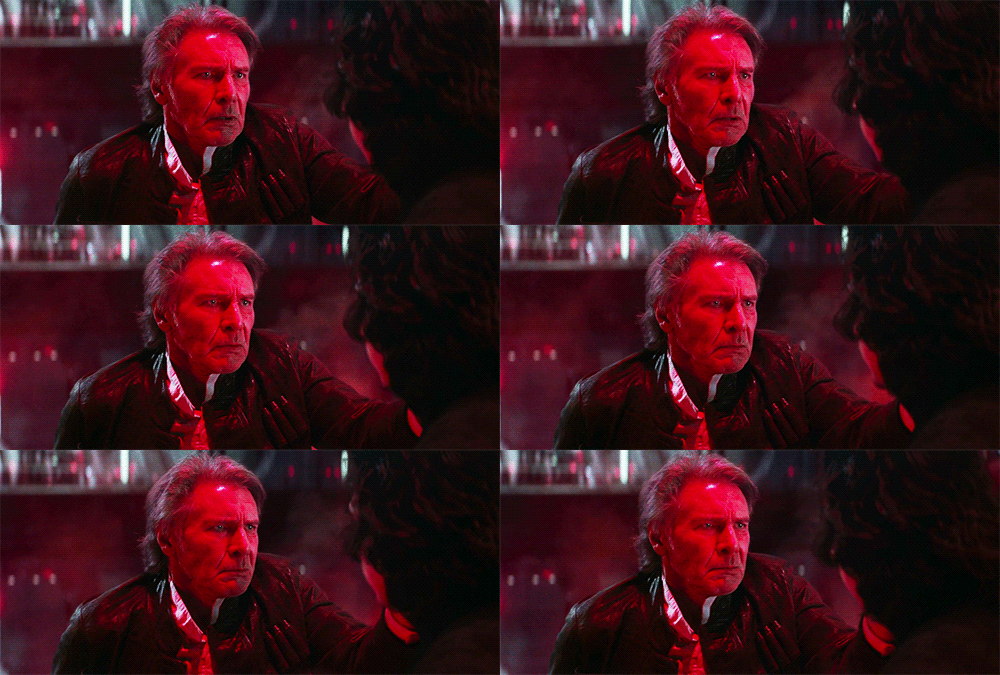
Dropping his helmet to his feet, Kylo holds out his lightsaber as if to surrender. But as Han puts his hand on it the sun, depleted of energy, goes dark. The First Order’s weapon is now charged. The light fades and a shadow falls over Kylo Ren. He tenses his grip on the lightsaber and ignites it, killing Han and throwing him into the chasm below.

As I mentioned in a previous post, this confrontation follows the model laid out in the "Atonement with the Father" chapter of Joseph Campbell's The Hero with a Thousand Faces. Luke accomplished this atonement in EPISODE VI by choosing to redeem Vader rather than destroying him. In doing this he becomes the hero his father could have been rather than the monster he became.

Vader had accidentally engineered this awakening of purpose in Luke through his murder of Obi-Wan Kenobi. By removing the surrogate father, he forced Luke to seek atonement with his real father and in doing that, he insured that Luke would face his greater destiny.

In a sense, Kylo’s murder of Han may signify the same type of awakening for Rey. He is robbing her of her surrogate father and mentor, which will ultimately force her to accept the truth about her real family, and perhaps her real destiny. Without knowing where the story is headed, there’s no telling what the far-reaching effects of this action will be for her, but by killing Han, Kylo has definitely shifted the conflict into being solely about himself and Rey, adding a personal element that did not previously seem to be a part of their struggle.

But it’s how this atonement impacts Kylo and Han that I find the most interesting here. As I said before, this scene for Han mirrors Luke’s final confrontation with Vader in EPISODE VI, where he’s forced to address a personal emotional dilemma while external forces are actively working to blow them all up before he can reach its resolution. Whereas Luke was making his final appeal for the redemption of his father, Han is making his final appeal for the redemption of his son. And where Luke was ultimately successful in saving his father’s soul (albeit at the cost of his father's life), Han ultimately fails to save Kylo’s soul, losing his own life in the process.

But is that what’s really going on here?

What I find absolutely fascinating is that the atonement we’re witnessing is that of Kylo Ren confronting his own father just as Luke did in EPISODE VI. Kylo’s arc parallels Luke’s exactly here. He is confronting his father to prove that he can overcome his influence and thus complete his own personal transformation into something greater. Just as Luke had to do when he confronted Vader and the Emperor, Kylo is forced to complete his journey alone. The base is stupid with Stormtroopers, but the only other characters present to witness this moment are Han’s friends. Kylo has to face this trial alone and stand by his philosophical convictions without the benefit of any other influences to help him. That’s what makes this such a heartbreaking scene. He truly believes that his path is to transcend what his parents want of him to realize a higher calling, which is everything the atonement is meant to achieve. The at-one-ment doesn’t occur when you concede to be as your father dictates. It occurs when you assert yourself to hold to your own path, thus becoming your own self-actualized being, and in so doing, becoming your father.

What makes this such a powerful scene is that Kylo is not toying with Han’s emotions and is not in any way being insincere. He feels torn apart and desperately wants to remain strong enough to do what he believes must be done. He asks Han to help him and, believing Kylo needs the strength to leave the Dark Side behind and come home, Han agrees to help him do anything he needs to that purpose. And it is actually this at-one-ment between Kylo and his father that gives him the strength to take what he believes is the final step toward making his transformation complete. If he can murder his own father, then there can be no going back.


"Thanks for you help, Dad. I feel like you're really starting to get me, you know?"
It’s important to note that Han’s shock and despair is genuine, but so was his offer. He put himself at Kylo’s mercy, allowing him to make the choice he needed to make. Obviously, this is not the choice Han would have preferred, but he dies believing in his son and even at the last, he dies loving him. When Kylo thanks him, Kylo is being completely sincere. And this scene is perfectly, wonderfully heartbreaking for that.

http://45.media.tumblr.com/bedc010425ee25234afc692a6c2a4713/tumblr_o4kp7hNlIm1rp4uy8o2_500.gif
But does this represent an actual failure on Han’s part to redeem his son?

Ostensibly, the answer would be yes. Han is killed, murdered by his own son, and Kylo Ren is resolved to continue down the path to the Dark Side of the Force. But let’s look a little more closely at the outcome of the confrontation. Han falls down a chasm, literally crossing Campbell’s “Sun Door”, the path to ascension that allows the mortal hero to transcend the mortal world and become something more.


Compare Han's fall to Luke's sacrifice on Bespin...


Han sacrificed himself for his son. This sacrifice seems to have been in vain, but may have far-reaching consequences of its own at a later point in the story.

What we see in Kylo’s attempt at atonement is the consequence of the uninitiated son attempting to usurp the father before he is ready to do so. Just as we see Luke fail in EPISODE V because Obi-Wan and Yoda have ill-prepared him for his confrontation with Vader, so we see the same failure of Kylo to confront his own father in EPISODE VII. While Luke was not properly initiated due to having been tragically ill-informed as to the exact nature of his relationship with Vader, Kylo’s improper initiation appears to have a more complex set of factors behind it. His history is hinted at being more akin to that of young Anakin, where we was stripped away from all parental influence and torn between the forces of light and darkness, both trying to pressure him into becoming something without any proper consideration for his personal needs or desires.

Just as we did with Anakin, we see the ensuing chaos that comes from Kylo’s improper initiation. He rebelled against Luke and his teachings, allowing himself to be used and manipulated by Snoke. Like Anakin before him, Kylo rebels against the chaos of his personal life by focusing on any path that promises the establishment of order.

In the “Atonement with the Father” chapter of The Hero With a Thousand Faces, Joseph Campbell recounts the parable of Phaethon, who was sired by the sun charioteer Helios. Learning his father’s identity, the young man seeks him out. The Sun God is so pleased that he offers to grant anything his son desires. Being an impetuous youth and wishing both to impress his father and to prove his lineage to his peers, the boy insists on flying the sun chariot just once in his father’s stead. Failing to dissuade him from this ill-advised request, Helios concedes to keep his promise.


This is also a kind of parable warning against the making of open-ended oaths,
but that's a discussion for another time.
So Phaethon takes the sun chariot for a catastrophic spin around the world, scorching the Earth and the sky and just generally making a mess of the place until the other gods have to intercede. This is an unsuccessful atonement with the father because he has not been properly initiated into his role and is not yet ready to become his father.


I don’t know if this is a general rule in terms of the at-one-ment act, but in STAR WARS the proper distinction is easy to draw based on intent. If the young man seeks to become or destroy his father, then he is not yet ready to succeed him. By confronting Obi-Wan, Anakin was not trying to become him, but he was trying to prove to Obi-Wan and himself that he was better. In a more metaphysical sense, he was trying to become the dark shadow that had created him. While his second duel with Kenobi took place after he had assumed a more powerful and profoundly realized role, he was equally unsuccessful in his effort to replace his former master because he was not a self-actualized being. He was operating as a functionary of the social machine, a puppet of the Emperor and the Dark Side of the Force. Only in his final act in EPISODE VI, when Anakin embraced his role as a father and his moral accountability for his actions, did he succeed in achieving the type of transformation that is typical of the son’s atonement with the father. Anakin’s ultimate failure is that he only becomes a man in the final action of his life.

I've been neglecting Rey in these analyses thus far for a couple of reasons: First, there is a reflex prejudice in the STAR WARS saga that gives you an unfair predilection towards exclusively mythologizing its male protagonists. While the previous movies showcased strong female characters like Leia, Mon Mothma, and Amidala, these characters never factored into the mythic journey generally undertaken by the male Jedi. So it's easy to analyze this tradition through Kylo Ren, especially because we know he is descended from the same Jedi line as Luke and Anakin. We also actually get to see his atonement with the father play out in EPISODE VII, so his Father Quest is more relevant to the discussion at this point.

So far in the new trilogy we do not know Rey's lineage, but we can compare her to Luke and Anakin just as we did Kylo. Rey was not (to her knowledge) orphaned, but left behind. Like Anakin, she is doomed to a slave-like indenture working for Unkar Plutt. This allows her to survive the treacherous conditions in which she is forced to spend her childhood. Like Luke, she is fiercely loyal to her family, so she refuses to leave until circumstances compel her to serve a larger cause.

Rey is actually experiencing a reversal of the Father Quest, refusing to undertake her journey because she is holding out for her parents' return. Like Luke, she may find herself undertaking the journey unwittingly. Obi-Wan teased Luke's past with stories of his father, but Luke still believed his father to be dead when he agreed to go to Alderaan. His actions in the Death Star were focused on saving Leia, then after their escape his goal was to fight for the Rebellion. He didn't even know he was on a Father Quest until Vader finally told him in EPISODE V. Similarly, Anakin left his mother to seek the path of the Jedi, not his father, so any need for paternal reconciliation was never satisfactorily fulfilled.

Rey believes her father will return for her, so she is not moved to seek him out. Her adventure with BB-8 leads her to Han Solo, who is a surrogate father. In the course of that adventure, Rey is forced to face the possibility (at Maz Kanata's urging) that her father will never come back and she should instead focus on those who could. Rey assumes Maz is talking about Luke Skywalker, but Maz does not confirm this.


"Your father wanted you to have this when you were old enough... Wait, that's not right...
I mean, this belonged to Luke Skywalker and his father, so naturally it should be
passed on to YOU, for some reason...."
Without knowing exactly what happened before or after Kylo Ren's act of patricide, it’s difficult to say what the causes or the ramifications of it are. But let’s compare him to the ill-fated Phaethon. Rejected by his parents and pulled into an ideological conflict between Luke and Snoke, Kylo is a literal rage of emotions and, like Phaethon, literally sets fire to Earth and Heaven as a result. He is not ready to wield the power he has inherited and has not been taught how to be a man or a hero. Just like Anakin, Kylo is caught in the middle of larger events that no one bothers to properly explain and no one ever stops to think about how he is personally affected by it all. So Kylo is not ready when he faces Han Solo. He is simply trying to prove he is a man, which is something only a boy would need to do.

Han is ready to face Kylo now, after a lifetime of running away. Having been drawn back into the larger scope of events and having finally faced Leia, he saw that she believed in him and in their son and in the possibility that they could both be saved. So, like Luke did with Vader in EPISODE VI, Han puts himself completely at his son’s mercy. Han has already risked everything to save the galaxy as a whole. This final act of pure selfless love is performed in an effort to save his son.

Kylo is not ready for this. He believes that killing Han will establish his independence and cement his resolve for Snoke’s teachings, but this does not happen. Kylo seems just as confused and conflicted as he was before he confronted Han. This action has not made him any more focused or committed to his course. This is demonstrated in the fact that Chewbacca is able to get a hit on him before Kylo even realizes he’s being fired on, when we have see he can stop a laser bolt in its tracks when he’s paying attention.

So killing his father did not have the effect Kylo Ren had hoped for, but might it have had the effect Han Solo had hoped for? That’s a question for another time.